Every Door Direct Mail (EDDM) lets you reach entire neighborhoods without a mailing list, starting at $0.260 per piece. Here's how to select the right carrier routes, read the demographic data behind them, and choose between EDDM Retail and BMEU for your campaign.
Summary
- An EDDM route is a USPS carrier route, typically 300 to 500 homes, and selecting one means mailing every active address on it, with no way to cherry-pick individual households.
- Use the Oppizi or USPS EDDM tool to filter routes by age, income, and household size before committing to a mailing.
- EDDM Retail, no permit, 5,000-piece daily cap per ZIP code, suits most local campaigns. EDDM BMEU, permit required, no cap, is for high-volume, multi-market mailers.
- EDDM Retail postage starts at $0.260 per piece, with a 200-piece minimum per day per ZIP code.
- EDDM is a USPS product. Outside the US, look for your own postal operator's version, such as Australia Post's Unaddressed Mail or Canada Post's Neighbourhood Mail.
Every Door Direct Mail (EDDM) lets you reach customers right where they live, with EDDM Retail postage starting at $0.260 per piece and no mailing list required. By targeting entire neighborhoods instead of individual addresses, EDDM campaigns eliminate the need for a mailing list while delivering to every active address on your selected routes.
The success of your campaign heavily relies on choosing the right mailing routes. Let's explore how to plan and select EDDM routes strategically to reach your ideal audience and optimize your campaign results.
A quick note before we dive in: EDDM is a USPS product, so everything below applies to campaigns in the United States. Running unaddressed mail elsewhere? Look for your own country's version under its own name. Australia Post calls it Unaddressed Mail, and Canada Post calls it Neighbourhood Mail. The route logic is similar everywhere, but the specific rules, pricing, and tools in this guide are USPS-specific. Oppizi runs campaigns in 12+ countries, so if you're mailing outside the US, talk to us about the right channel for your market.
What is an EDDM route?
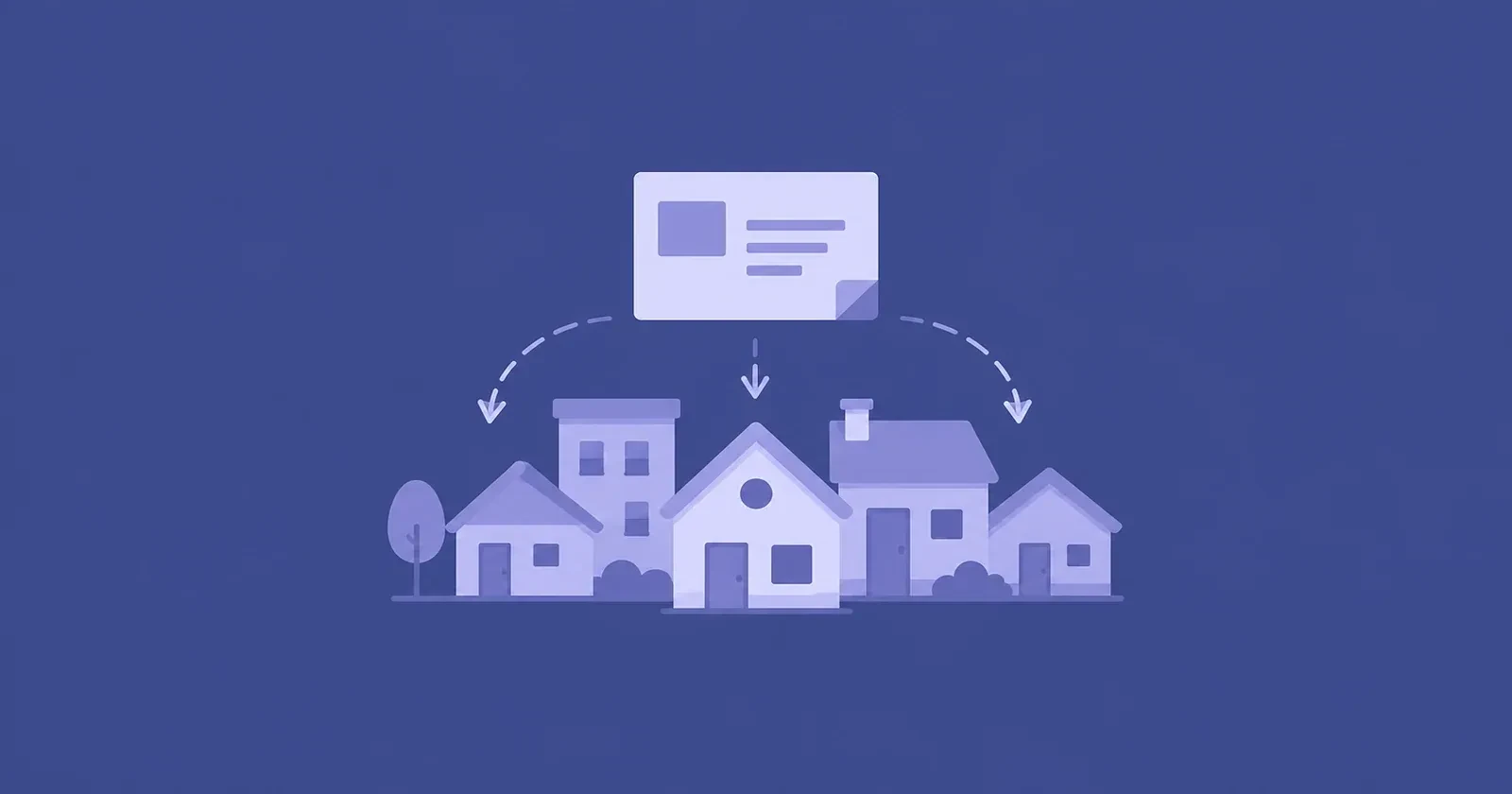
An EDDM route, formally called a carrier route, is a specific geographic delivery path assigned to a single USPS mail carrier. Each route covers a defined set of addresses, typically between 300 and 500 residential deliveries, though the number varies by area. When you select a route for an EDDM campaign, every active address on that route receives your mailpiece. There are no individual household selections and no mailing list required: coverage is automatic and complete.
Understanding your target audience
Before selecting EDDM routes, defining your target audience is essential. EDDM campaigns are most effective when your message reaches those most likely to engage with your business. Start by setting SMART objectives to clarify your campaign goals. Additionally, consider the following:
Defining demographics
Consider the age, income, household size, and lifestyle of your ideal customers. For instance, if you own a yoga studio, your audience might include young professionals or health-conscious individuals in middle-income brackets. Or if you're promoting a local event aimed at families, you may want to target larger household sizes.Pinpointing behaviors and preferences
Think about what your audience values and how your product or service meets their needs. For example, a meal delivery service could target busy professionals who value convenience, highlighting time-saving benefits. Aligning your message with audience motivations increases engagement.
Setting geographical boundaries
If your business serves a specific area, such as a local restaurant or salon, ensure your target audience resides within a reasonable distance. For instance, a local pizzeria might focus on neighborhoods within a 5-10-mile radius, highlighting delivery options and special promotions to attract nearby customers. Clear boundaries help maximize your campaign's impact.
With a clear understanding of your audience, you're ready to choose routes that align with your campaign goals.
Using EDDM route planning tools
EDDM route planning tools, like Oppizi or the USPS EDDM Online Tool, give you demographic data and delivery counts for every carrier route before you commit. These tools provide detailed information about residential and business delivery routes, including key demographic data such as average age, household size, and income.
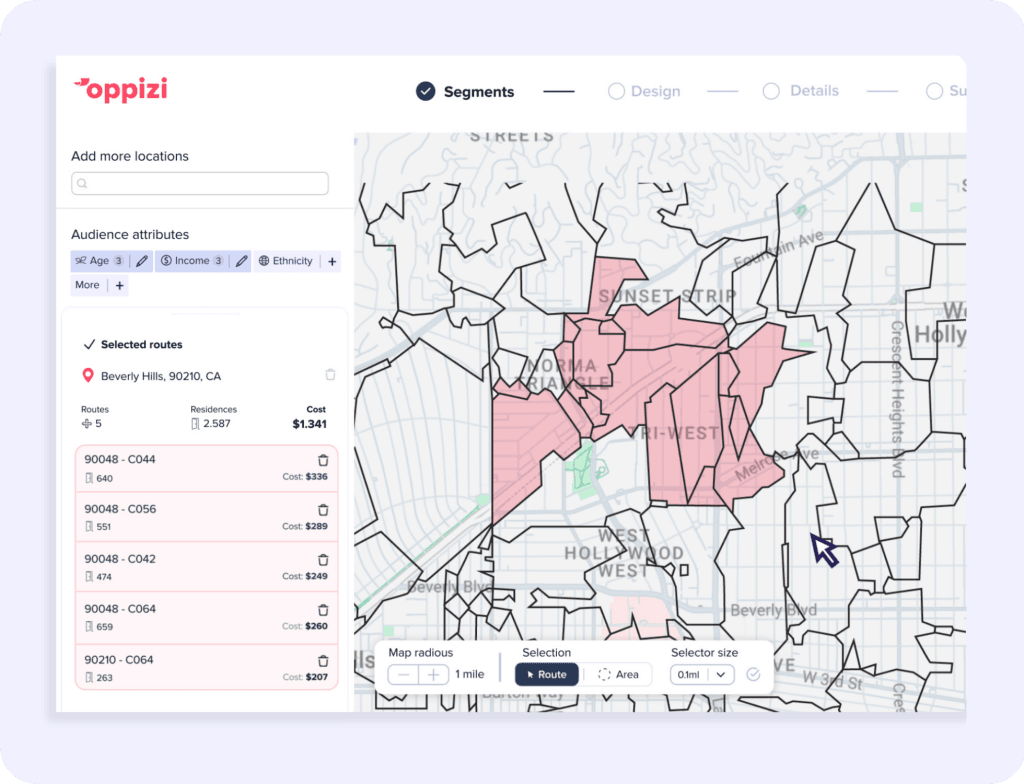
Here's how to use them, step by step:
- Search by location. Enter a ZIP code, city, or full address to load all available carrier routes in that area on an interactive map.
- Switch to Table view. Click "Show Table" to compare routes side by side. Each row displays the route number, residential addresses, business addresses, total deliveries, average age, average household size, average household income, and estimated cost, all in one place.
- Apply demographic filters. Narrow routes by age range, household size, or income level to focus on the areas where your ideal customers are concentrated. These figures are drawn from U.S. Census data, so use them directionally rather than as precise counts.
- Select your routes. Click individual routes on the map or table to add them to your order. You can select multiple routes for a single mailing, which is useful for blanketing a full neighborhood or expanding into adjacent areas.
- Review your Order Summary. Before finalizing, check your total mailpiece count and estimated cost. EDDM Retail requires a minimum of 200 mailpieces and allows up to 5,000 pieces per day per ZIP code.
With Oppizi, you can streamline your campaign planning process and make data-driven decisions to improve your reach and ROI.
Selecting routes based on demographics
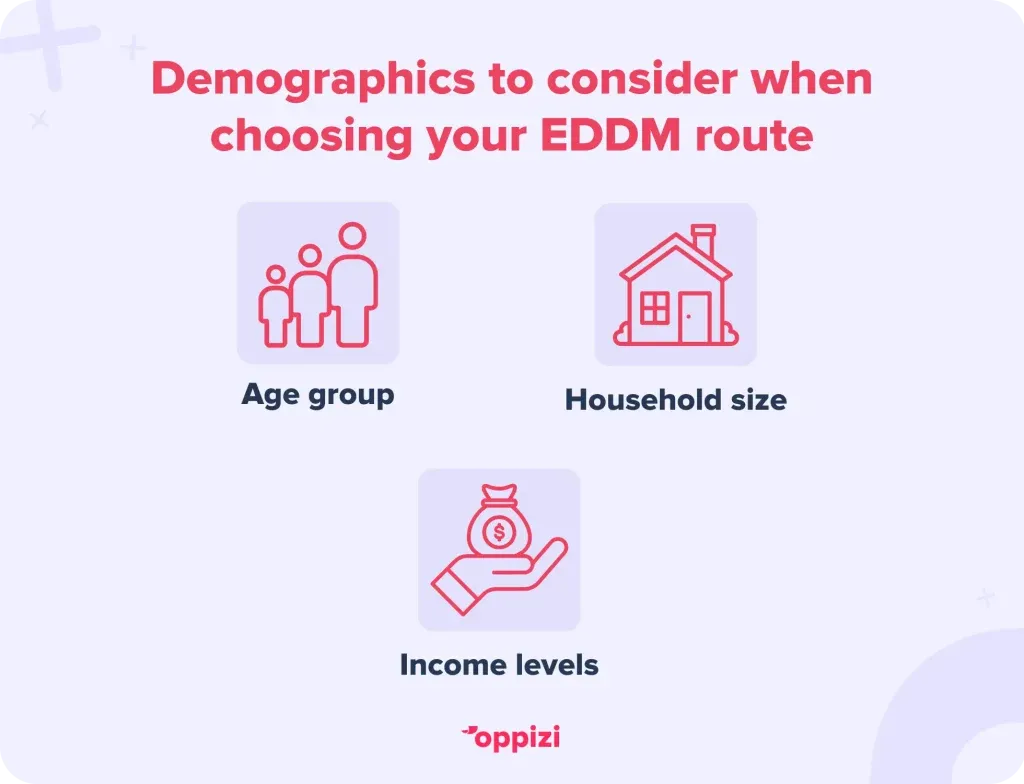
Demographics are a cornerstone of successful EDDM campaigns. Tailoring your route selection to match the characteristics of your target audience improves response rates by putting your message in front of households most likely to act.
- Income levels: Businesses offering premium products or services should focus on areas with higher-income households, while budget-friendly offerings may target middle-income communities.
- Age groups: If you run a daycare or toy store, prioritize routes with a high percentage of young families. Conversely, a senior living facility might focus on routes with older residents.
- Household size: Products and services catering to larger families, like grocery delivery or home improvement, benefit from targeting areas with more multi-person households.
- Residential vs. business mix: You can filter routes to include residential addresses only, or residential plus business addresses. For most local campaigns, residential-only routes are the right call. If you're marketing to offices or commercial tenants, include business deliveries, but check the business address count for each route before selecting, since the mix varies significantly.
Balancing coverage and budget
When planning an EDDM campaign, it's tempting to cover as many routes as possible to reach as many people as possible, but broader coverage doesn't always equate to better results. Instead, focus on reaching the relevant audience:
- Narrow your target area: Select routes with demographics that align most closely with your audience. Prioritize routes closest to your location or service area first, then expand outward if you need more volume.
- Consider response potential: A smaller, well-targeted campaign often outperforms a larger unfocused one because every mailpiece lands with a relevant household.
- Optimize volume: EDDM Retail requires a minimum of 200 mailers per route and caps at 5,000 pieces per day per ZIP code. Plan your route selection around these limits to avoid splitting campaigns unnecessarily.
EDDM Retail vs. EDDM BMEU: which option is right for you?
Once you've selected your routes, you'll need to choose how you submit your mailing. USPS offers two options, and the right one depends on your volume and how hands-on you want to be.
| EDDM Retail | EDDM BMEU | |
|---|---|---|
| Best for | Small businesses, local campaigns | High-volume mailers, agencies |
| Volume limit | 200-5,000 pieces per day per ZIP code | No upper limit; multiple ZIP codes in one mailing |
| Drop-off location | Local Post Office | USPS Business Mail Entry Unit (BMEU) |
| Permit required | No | Yes (USPS Marketing Mail permit) |
| Payment | Online or at the Post Office | Bulk mailing permit |
For most local businesses running neighborhood awareness or launch campaigns, EDDM Retail is the faster, lower-friction option. If you're scaling to tens of thousands of pieces across multiple markets, BMEU unlocks higher volume without the daily ZIP code cap.Tips for effective EDDM route planning
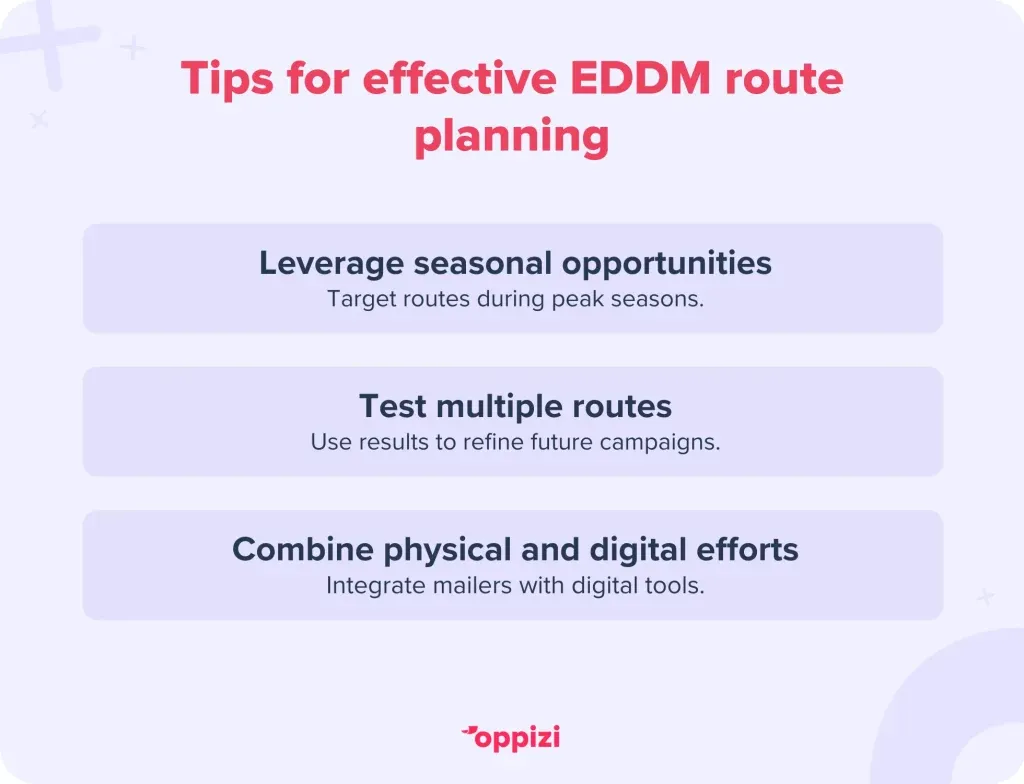
To make the most of your EDDM campaign, keep these tips in mind:
- Leverage seasonal opportunities: Some routes may be more effective at specific times of the year. For example, neighborhoods with young families may respond well to back-to-school promotions.
- Test multiple routes: Launch your campaign in a few key areas first, then analyze results like response rates. Use insights to refine your targeting for future campaigns.
- Combine offline and online marketing efforts: Enhance the impact of your mailers with digital tools like QR codes or dedicated landing pages to track engagement.
Conclusion
Selecting the right mailing routes for your EDDM campaign is crucial to achieving your marketing goals. By leveraging tools like Oppizi or the USPS EDDM Online Tool, analyzing demographics, and focusing on audience relevance, you can create a targeted campaign that reaches the households most likely to respond.
With Oppizi, you can plan, execute, and optimize your EDDM campaigns from start to finish. Whether you're a small business or a growing company, you'll have the tools to reach the right audience at the right time.
Ready to reach local audiences? Launch your EDDM campaign with Oppizi today.
Frequently asked questions
- Is there a minimum number of EDDM mailers that can be sent?
Yes. EDDM Retail requires a minimum of 200 mailpieces. There is also a maximum of 5,000 pieces per day per ZIP code for Retail mailings. If your campaign exceeds that volume, EDDM BMEU has no upper cap and allows multiple ZIP codes in a single mailing.
- Can I target specific households within a route?
No. EDDM delivers to every active address on a selected route. That's the trade-off for not needing a mailing list. Demographic filters let you choose routes where your ideal customers are most concentrated, but you cannot exclude individual addresses within a route.
- Can I use EDDM for business-to-business campaigns?
Yes. When selecting routes, you can filter to include business addresses alongside residential ones. Effectiveness depends on the density of relevant businesses in a given route, so this works best in commercial corridors rather than purely residential neighborhoods.
- How many households are typically in an EDDM route?
It varies by area, but most USPS carrier routes contain between 300 and 500 residential delivery points. Urban routes tend to be denser; rural routes can be smaller. The EDDM tool shows the exact residential and business address count for each route before you commit, so there are no surprises on volume or cost.
- Can I choose specific carrier routes by ZIP code?
Yes. Enter a ZIP code into the EDDM tool and it will display every available carrier route within that ZIP. You can then select individual routes, not just the entire ZIP, which means you can target one side of a neighborhood without mailing the other. Multiple routes can be selected and combined into a single mailing order.