Direct mail and EDDM solve different problems: one targets specific households, the other blankets a neighborhood. Here's how they compare on cost, targeting, and size requirements, and when to use each or combine them in one campaign.
Summary
- EDDM blankets every address on a postal route with no mailing list, while direct mail targets specific people by name
- EDDM Retail postage starts at $0.260 per piece with no permit required; direct mail through Oppizi runs $0.54 to $0.65 per piece with data included and no monthly fee
- EDDM can't target by demographics or purchase history, only by carrier route and residential or business filtering
- A mailpiece must clear a 6.125-inch height or 11.5-inch length threshold to qualify as an EDDM flat
- Starting with EDDM for broad awareness, then following up with targeted direct mail, is the strongest way to use both
Want to get your message in front of the right people? If you're looking into print marketing, you've probably heard of direct mail and EDDM. But which one is right for you?
Here's a simple breakdown of both, including what each one actually costs and when to use one over the other. Whether you're promoting an event, launching a product, or trying to get more customers, knowing how these options work will help you pick the best one.
What is EDDM?
EDDM (Every Door Direct Mail) is a USPS program that lets businesses send mail to entire neighborhoods, no address list needed. Instead of picking specific people, you choose postal routes, and your mail goes to every home or business along that route.
Why use EDDM?
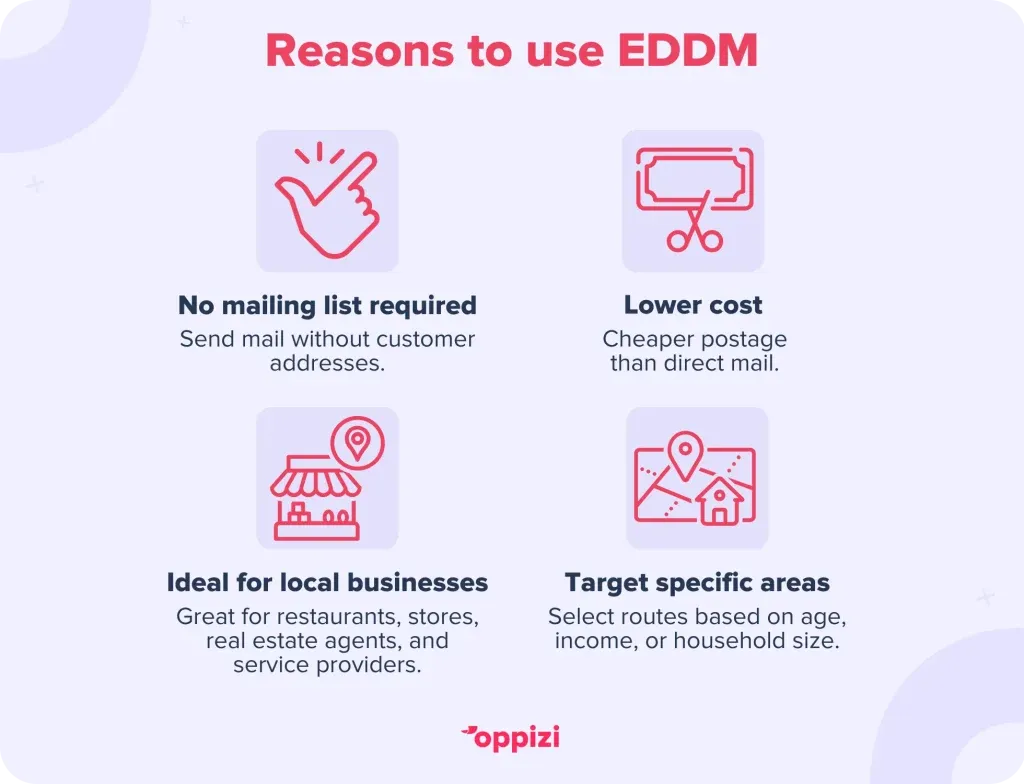
- No mailing list needed: you don't need customer addresses
- Lower postage: EDDM Retail runs $0.260 per piece, with no USPS permit required
- Great for local businesses: perfect for restaurants, stores, real estate agents, and service providers
- Target by area: choose mailing routes based on age, income, or household size
Advantages and disadvantages of EDDM
Here are some of the benefits of Every Door Direct Mail and drawbacks that you should consider.
Pros
- Reach a lot of people: your mail goes to every address on the route
- Lower cost: EDDM Retail postage starts at $0.260 per piece, cheaper than addressed direct mail
- Easy to set up: no mailing list or complex planning
- Boosts brand awareness: more people see your business
Cons
- No personalization: you can't address people by name, only "Postal Customer"
- No targeting beyond geography: you can filter by residential or business addresses, but not by income, age, or purchase history
- Not everyone will be interested: some recipients may ignore it
EDDM works well when you want to reach as many people as possible in a specific area. It's a simple, budget-friendly way to spread the word.
Who should use EDDM?
EDDM is great for businesses that want to reach a lot of people in one area. Here are some ways it's used:
- New restaurants: send menus and special offers to the whole neighborhood
- Real estate agents: show off listings and invite homeowners to open houses
- Home services: advertise deals on lawn care, roofing, or pest control
- Retail stores: announce grand openings, sales, or special events
- Gyms and fitness centers: offer free trials or membership discounts to locals
It's a simple, affordable way to get noticed in your community.
What is direct mail?
Direct mail is a targeted way to reach customers. Instead of sending mail to everyone in a neighborhood, you send it to specific people on a mailing list, either your own customer data or a purchased list. Businesses use it to send postcards, brochures, or catalogs directly to the right audience.
Why use direct mail?
Here are some of the key reasons why you'd consider running a direct mail campaign.
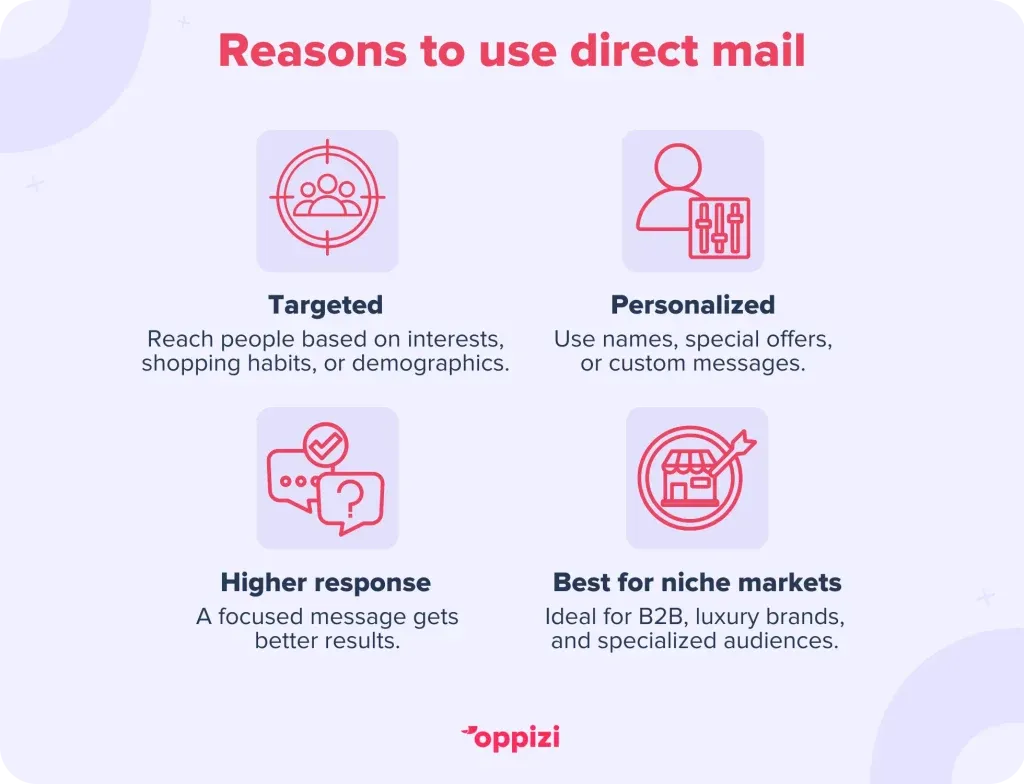
- Highly targeted: reach specific people based on interests, shopping habits, or demographics
- Personalized: use names, special offers, or custom messages to make it feel personal
- Priced for the targeting you get: Oppizi's addressed direct mail runs $0.54 to $0.65 per piece with data included and no monthly platform fee
- Great for niche marketing: works well for B2B services, luxury brands, and businesses with a specific audience
Advantages and disadvantages of direct mail
Pros
- It's personal: messages can be tailored to individuals
- It builds loyalty: helps strengthen customer relationships
- It's precise: ideal for targeting high-value customers
Cons
- It costs more: postage and mailing lists add up, at $0.54 to $0.65 per piece versus EDDM's $0.260
- It takes more effort: you need to collect and manage customer data
- It requires planning: finding the right audience takes time
Direct mail takes more work than EDDM, but it also gives you more control over who sees your message.
Examples of direct mail campaigns
Direct mail works best when you want to reach a specific group of people with a personal touch. Here are some common ways businesses use it:
- Luxury brands: sending catalogs to high-end shoppers
- Nonprofits: asking past donors for support
- Dental offices: reminding patients about appointments or offering discounts
- E-commerce stores: rewarding loyal customers with special offers
- Financial advisors: reaching high-income households with investment services
Direct mail lets you send the right message to the right people. For instance, attorneys can use direct mail to send postcards to local residents that highlight their services or recent successes, building credibility and attracting new clients.

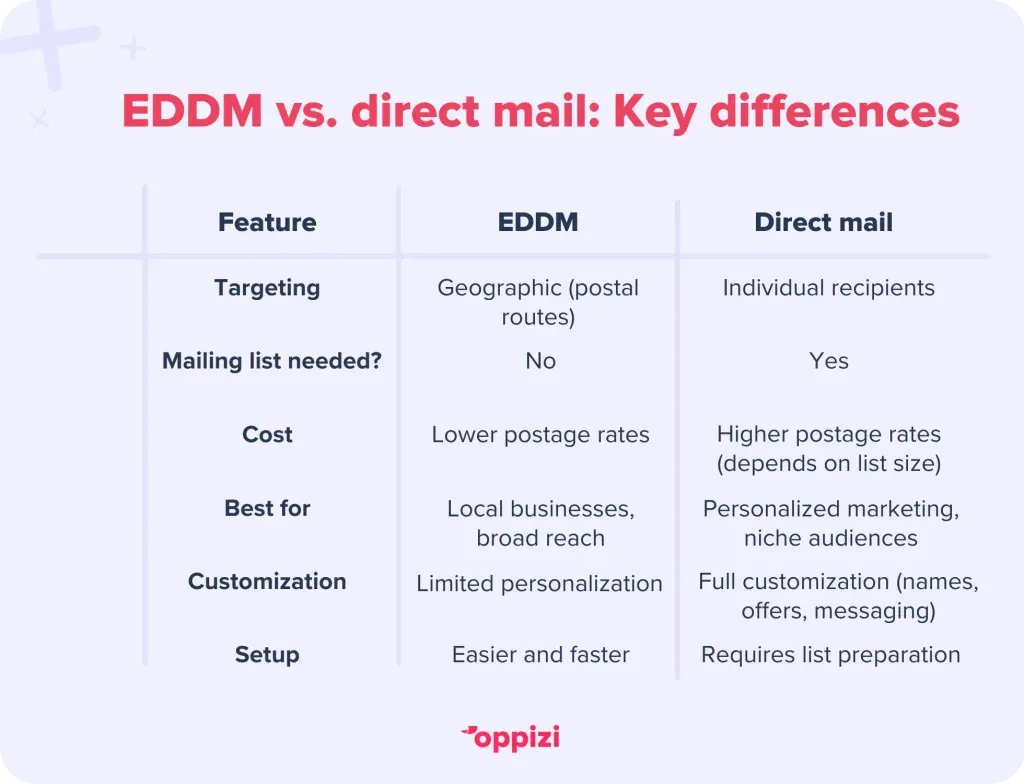
EDDM vs. direct mail: Key differences
Let's take a look at unaddressed EDDM and addressed direct mail side by side. Each has its strengths, but they work differently. Here are the details to weigh before choosing the right option for your business:
| Feature | EDDM | Direct Mail |
|---|---|---|
| Targeting method | Carrier routes (geographic) | Mailing lists (demographic, behavioral) |
| Mailing list required | No | Yes |
| Personalization | None, addressed to "Postal Customer" | Recipient's name, variable data |
| Postage per piece | $0.260 (EDDM Retail) | $0.54 to $0.65 with data included |
| Permit required | No (EDDM Retail) | No, with Oppizi |
| Volume per ZIP per day | 200 to 5,000 pieces | No USPS-imposed daily cap |
Is EDDM cheaper than direct mail
On a per-piece basis, yes. EDDM Retail postage sits at $0.260 per piece, and commercial saturation rates run slightly lower at $0.258 per piece if you have a USPS permit. Once you add printing and service costs, all-in pricing for EDDM usually lands around $0.45 per piece.
Direct mail through Oppizi runs $0.54 to $0.65 per piece with data included and no monthly platform fee, covering list acquisition, printing, and postage in one line item. The higher cost reflects what you're getting: the ability to target specific households and personalize the message instead of paying to reach everyone on a route.
- EDDM wins when: your offer appeals to nearly everyone in a geography, like a pizza shop mailing to every home within two miles
- Direct mail wins when: your offer appeals to a specific audience, like a financial advisor targeting high-net-worth households
Can you target specific households with EDDM
No. EDDM delivers to every address on a route, which is the whole point of the program. You can filter by carrier route selection, choosing residential-only, business-only, or both, but you can't filter by income, age, purchase history, or any other demographic variable. If the address sits on the route, it gets the mail.
If household-level precision matters to your campaign, addressed direct mail is the only path forward.
EDDM size, weight, and volume requirements
USPS has specific requirements for EDDM pieces. Miss one, and your mail won't qualify for the program.
- Size minimums: 5 x 3.5 inches, 0.007 inches thick
- Size maximums: 15 x 12 inches, 0.75 inches thick
- Flat-size threshold: piece must exceed 11.5 inches long, 6.125 inches high, or 0.25 inches thick to qualify as a flat
- Weight cap: 3.3 oz for EDDM Retail
- Volume per ZIP per day: 200 to 5,000 pieces
The flat-size threshold trips up a lot of first-timers. A standard 6.5 x 9 postcard qualifies because its 6.5-inch height clears the 6.125-inch threshold, while a 6 x 9 postcard falls an eighth of an inch short and does not qualify.
Which one should you choose?
Not sure which one to use? It depends on your business, budget, and overall objective.
- EDDM: go with EDDM if you want to reach a lot of people in a specific area without a mailing list. It's great for restaurants, real estate agents, and service businesses looking to get noticed locally.
- Direct mail: pick direct mail if you need to target specific customers. It works well for luxury brands, B2B services, and businesses that send personalized offers.
You can also use both: start with EDDM to introduce your business, then follow up with direct mail to turn interest into sales.
Still not sure which one to choose? Ask yourself:
- Who are you trying to reach? EDDM works best if you want to reach everyone in a neighborhood. Direct mail is better if you have a specific type of customer in mind.
- What's your budget? EDDM is cheaper for reaching a lot of people, at $0.260 per piece. Direct mail can be worth the $0.54 to $0.65 per piece if you're targeting the right audience.
- Do you need personalization? Direct mail lets you add names, custom offers, and personal touches. EDDM is more about getting your name out there.
- What's your goal? Use EDDM for brand awareness and foot traffic. Use direct mail if you want to build relationships and get repeat customers.
Your answers will help you pick the right approach.
Use digital marketing to boost your mail campaigns
Whether you go with EDDM or direct mail, adding digital marketing can help you get better results. When people see your message in more than one place, they're more likely to remember it and take action.

How to combine mail and digital marketing
- QR codes for quick action: add a QR code to your mailer so people can visit your website, sign up for an offer, or follow you on social media with one scan
- Retargeting ads: if someone visits your website after getting your mailer, show them digital ads to keep your business top of mind
- Email follow-ups: get people to join your email list so you can send them future offers and updates
- Social media connections: use mail to send people to your social pages, where they can engage with your brand
- Custom landing pages: create a special webpage for each mail campaign to track responses and give more details
Using both print and digital marketing helps you stay in front of your audience and makes your campaigns more effective. Per USPS's own research, combining the two has been shown to increase website visits by 68%, ROI by 60%, leads by 52%, and in-store visits by 39%.
Direct mail and EDDM made simple with Oppizi
Print marketing doesn't have to be complicated. At Oppizi, we handle the design tools, printing, tracking, and delivery. Whether you're using EDDM or direct mail, our platform makes it easy to launch a campaign in just a few clicks.
Sign up today and let Oppizi take care of the details. We'll get your message into the right hands, without the hassle.
Frequently asked questions
- What is the difference between direct mail and EDDM?
Direct mail targets specific people using a mailing list, which allows for personalization and precise targeting. EDDM (Every Door Direct Mail) sends mail to every address along a postal route without a list. It's a cost-effective way to reach a local audience but lacks the precision of direct mail.
- What response rate should I expect from EDDM or direct mail?
Cold, addressed direct mail averages a 1% response rate, and door drops like EDDM average 0.3%, UK-measured, per the JICMAIL Response Rate Tracker, which measured 4,939 UK campaigns through matchback and tracking codes rather than by survey. Your own number depends on list quality, offer strength, and creative, so track your first campaign as a baseline.
- Is EDDM worth it?
Yes, EDDM is an affordable way to reach a lot of people in a specific area, with postage starting at $0.260 per piece and no permit required. It's great for small businesses promoting grand openings, special deals, or community events. But if you need precise targeting or personalization, direct mail is the better choice.
- Is direct mail still effective today?
Yes. Direct mail stands out because inboxes are overcrowded. When designed well, it grabs attention and drives results. Businesses that personalize their mail and track responses get even better outcomes, especially when combining it with digital marketing.
- What is a major disadvantage of direct mail?
Cost. Direct mail runs $0.54 to $0.65 per piece with data included, well above EDDM's $0.260, because it involves list acquisition, personalized printing, and postage. Managing customer data also takes time. But for businesses that need precise targeting, the results often make up for the cost.
- What is the future of direct mail?
Direct mail is getting smarter. QR codes, personalized URLs, and better data analytics are helping businesses target the right people and track what works. Combined with digital marketing, direct mail stays a strong, measurable channel.